PRF in Dentistry: Great Guide for Dental Professionals
Platelet-Rich Fibrin (PRF) is a natural biomaterial and an autologous one that is applied in the purpose of modern dentistry in order to improve functionality and outcomes of the healing process, tissue regeneration and surgery. It is made of the own blood of the patient, facilitates the process of bone and soft tissue healing, decreases the number of complications after surgery and leads to a more rapid healing process of the individual undergoing that surgery (i.e. Tooth extraction, dental implants, periodontal surgery, oral/maxillofacial procedures).
You can visit our previous article if you’re concerned about chlorhexidine mouthwash.
What is PRF?
Platelet-rich fibrin refers to a second-generation platelet concentrate that is full of platelets, leukocytes, and growth factors. In comparison to Platelet-Rich Plasma (PRP), it does not imply the use of anticoagulants or other chemical additives, which render it completely autologous and highly biocompatible. The natural fibrin matrix serves as a scaffold on which the tissues regenerate and promotes the process of angiogenesis- the formation of new blood vessels- required to heal a dental surgery.
The major distinction between PRF and PRP is that, at the time when PRP is a liquid suspension of platelets that are usually mixed with anticoagulants, while it is a clot-like membrane possessing a slow-release deposit of growth factors. This advantage not only enhances the regenerative effect but also renders PRF an extremely popular option in most dental surgeries in which bone and soft tissue reconstruction is of utmost priority.
How is PRF Prepared?
PRF is easy to make, inexpensive, and does not require a lot of time, so it can be prepared at the chairside, which is convenient both to the patients and dentists:
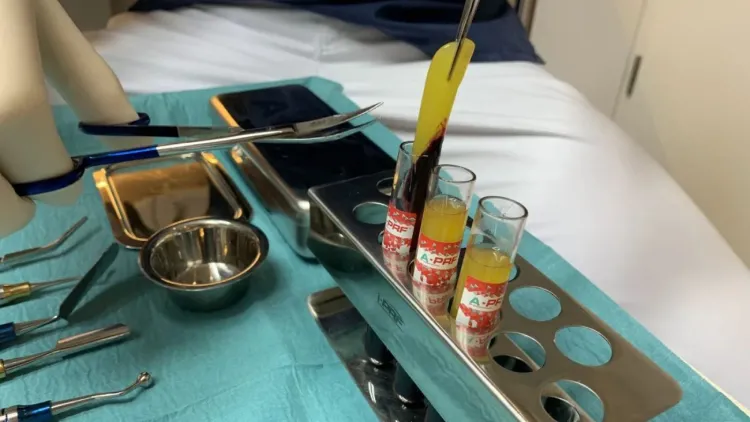
- Blood Collection: A small sample of blood of the patient is collected with the help of standard sterilised procedures.
- Centrifugation: The blood is centrifuged instantly at a certain speed and time so as to ensure the fibrin clot is cleaned away of the red blood cells. Time also plays an important role due to the fact that the formation of clots could be affected when centrifugation is performed slowly.
- PRF Harvesting: The fibrin clot that develops is softened and combines to produce a membrane byproduct or a plug. It is a membrane that may be applied onto the part of the body that is going to be operated on or in combination with bone graft materials to facilitate the healing process.
This is a simple method, which makes PRF a desirable, less invasive intervention to encourage tissue regeneration.
PRF in Dentistry
Dental Implants
PRF finds extensive application in implantology to augment the concept of Osseointegration, the direct structural connection between bone and implant. PRF is safer and has fewer side effects because when placed around the implant causes bone to grow faster and soft tissue to heal faster, thus preventing implant failure. The post-operative pain and swelling are reduced, and the recovery rate is greatly improved compared to traditional methods.
Periodontal Therapy
PRF is applicable in restoring lost bone and soft tissue in situations of periodontitis. Dentists can activate the regeneration of the periodontal ligament fibres, cementum and alveolar bone by putting PRF in periodontal defects or by using it along with bone grafts. This will lead to more stability of teeth, less pocket depth, and an aesthetic outcome.
Socket Preservation
PRF may be directly inserted into the extraction socket after tooth extraction. This is used to preserve the volume of the alveolar bone, facilitates the healing of the soft tissues quickly, and reduces the pain experienced after the procedure. PRF should be useful in socket preservation, especially for patients intending to undergo dental implants in future.
Oral and Maxillofacial Surgery.
PRF can also be used in more complex surgeries in the mouth, like sinus lift removal and bone grafting. Its regenerative effects aid in the reduction of swelling, reduce the chances of infection and speed up the healing of soft tissues and bones. This renders PRF as a very helpful adjunct in maxillofacial surgery.
Soft Tissue Healing
The PRF membranes may also be used on the gingiva to foster the proliferation of soft tissues. This is applied especially following periodontal surgery, placement of dental implants or acquiring gum grafts. Patients enjoy quick recovery, less pain after surgery and enhanced aesthetics.
Benefits of PRF
Autologous and Safe PRF is produced out of the blood of the patient and, therefore, the occurrence of immunologic reactions is reduced.
- Stimulates Healing: Its growth factors stimulate tissue regeneration and angiogenesis.
- Antimicrobial Properties: Its leukocytes assist in decreasing the chances of developing post-surgical infections.
- Cost-Effective: It is easy to prepare, can be used chairside, and is not associated with costly materials.
- Better Comfort: While less pain, swelling and post-operative pain are experienced, it still comes with better healing.
It is favoured by many patients compared to other cosmetic treatments, such as Botox or fillers, in cases where the desired outcome is the natural regeneration of the tissue instead of temporary appearance modification. Although it does not immediately reduce wrinkles like Botox, it rejuvenates the skin in the long run and has few side effects.
Limitations and Considerations
Although it is a very effective tool, it is not limitless:
- Time-stressful: Blood has to be taken to the lab right after a collection to preserve the integrity of the clots.
- Patient Variability: Its quality is subject to variations because of age, health issues, and medication.
- Skill-Dependent: Due to their care and positioning, it is highly important to obtain optimal results.
- Temporary Effects: It can increase the healing rate, but repeated use would be required in cases of aesthetic procedures, such as face rejuvenation or critical cases of periodontal defects. Follow-up treatments are usually set after every 3-4 weeks, depending on the procedure and reaction of the patient to the treatment.
The side effects are minimal and are often related to mild discomfort or immediate swelling at the injection or surgery site. OIna cases of standard protocols, the chances of serious complications are very low.
Longevity and Success Rate
It have long-term effects in the dentistry field as the growth factors are emitted gradually over 7-10 days, which encourages long-term tissue regeneration. According to clinical studies, dental implants, periodontal therapy, and bone grafting treatment have a high success rate, and they have much better results than those that do not employ PRF.
Patients who experience its treatments claim to have better healing, less bleeding, and fewer chances of post-operative infections. Although it is not to replace conventional dentistry, it is an important supplement to the natural healing ability of the body.
Cost of PRF
The PRF treatment cost is relative based on the procedure and the location of the clinic. It is used in dentistry and tends to be cheaper than the repeated PRP procedures or cosmetic product injections such as Botox or fillers. Dental surgical applications at clinics are billed between 150 and 500 dollars per session. PRP is potentially considered a little bit more expensive because of preparations and recurrent therapy; It gives long-term regenerative advantages at a comparatively low cost.
Comparison of PRF with Other Treatments
PRF has been adapted to PRP, Botox and dermal fillers:
- PRF vs PRP: It offers the advantage of delivering growth factors slowly over time, which is more suitable for tissue regeneration, whereas PRP is more viable in the short term.
- PRF/ Botox/ Fillers: PRF majors on the new tissue development as opposed to immediate aesthetic enhancement. Although fillers and Botox are best when it comes to producing instant cosmetic effects, they are the ones to use when it comes to long-term structural and tissue augmentation.
- PRF on Facial: It is often advised that multiple sessions with a sincere interjection of time (approximately a few weeks) are effective in achieving maximum rejuvenation.
Conclusion
Its dental and oral surgery has revolutionised dental and oral surgery by using the power of nature to replace itself. It use in implantology and periodontal therapy, oral surgery, and soft tissue healing is aimed at increasing the probabilities of improvement, fewer complications, and faster healing. Though not a direct replacement for cosmetic injectables, it has natural, long-lasting advantages that enhance both functionality and attractiveness.
It is a safe, functional, and versatile instrument that supplements old-fashioned treatments in the case of dentists. It can be applied to substantially improve the quality of care and patient satisfaction in up-to-date dental practice, provided that it is properly prepared, handled, and patients are selected.
Frequently Asked Questions
1. How is PRF different from PRP?
PRF is a fibrin clot that gradually releases growth factors, as opposed to PR, which is a liquid and results in quicker actions. PRF is maximally autologous and more effective in long-term tissue healing.
2. How long do PRF effects last?
PRF promotes prolonged healing through the release of growth factors in 7 -10 days. The cases can require a series of sessions to be successful.
3. Are there side effects of PRF?
The side effects are low in nature and are typically mild swelling or pain. Serious complications are extremely rare as PRF is prepared from the same patient’s own blood.
4. Is PRF cost-effective?
True, PRF is often less expensive than PRP or Botox treatments and has long-term regenerative advantages to the health of the teeth and soft tissue.